
Brunni Sledging Day Ticket
4.4(21)
fromCHF 48

8 Activities
Filter
Why book with Swiss Activities?
Why book with Swiss Activities?
Sleds have been around for thousands of years. In the past, they were used mainly for transportation. With the beginning of the 19th century, the sled is also used as a sports equipment
There are two types of sledges that are used in the majority in Switzerland. On the one hand, there is the legendary, good-natured and popular Davos sledge made of wood. On the other hand, we have the nippy toboggan, which with its sharp runners provides a good grip in the curves and a rapid descent
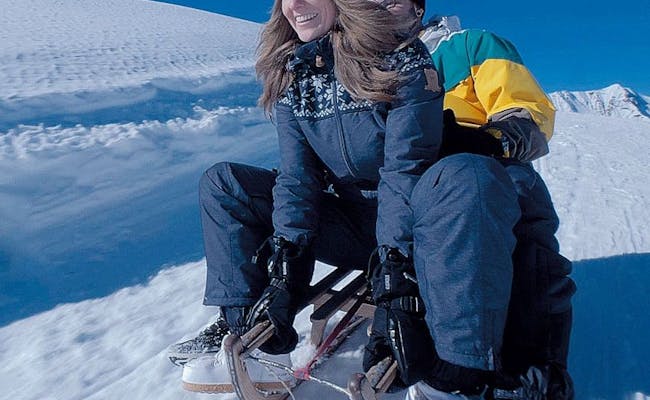 (Photo: Elsigen Metsch)
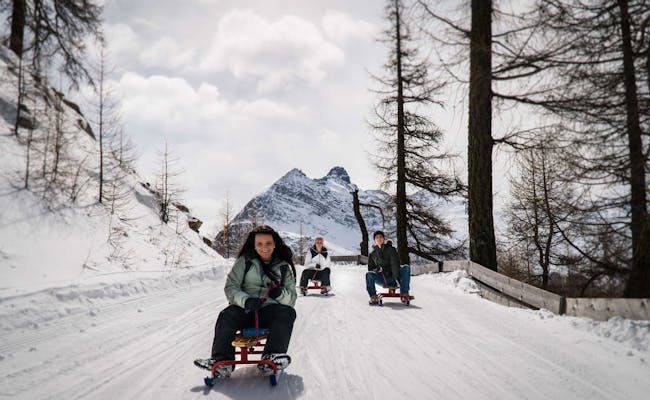 (Photo: Saastal Tourismus AG)
The sled is a traditional device for trips on snowy slopes and groomed slopes. Be it the simple wooden sled, the sleek sports equipment or the practical sled for the children Sleds and toboggans come in different models and lengths - for sitting or lying down. For the recreational toboggan of an adult, a length of 115 cm applies. Anyone who sleds with children knows: they quickly get tired or freeze. In this case, a suitable sled seat and a sleeping bag with warm lining are also recommended
The Davos sled, made of ash wood with iron-covered runners, fixed wooden construction and traction iron, was developed on the occasion of a sled race in 1883. This model is the origin of all recent sleds up to the racing bob. Anyone traveling with small children will appreciate the Davos sled
The Davoser is usually between 80 and 130 cm long and, unlike the toboggan, is steered and braked with the feet. Due to the fact that the Davos sled is slower than the toboggan, it is particularly suitable for leisurely descents with children. Due to the fact that there are also longer models, more than one person can easily ride on a sled.
 Sledging in Engelberg (Photo: Engelberg Titlis Tourism AG)
 Sledding on Rigi (Photo: Rigi Bahnen)
Unlike "normal" sleds, the runners on toboggan models are angled up to 25 degrees and are not rigidly connected. The runners, made of a special steel, make your device fast and agile. For maintenance, there are paste and liquid waxes that are applied after use. These also serve as rust protection. Special edge sharpening sets are available for sharpening blunt edges.
To ride, you sit on the tarp, lie backward, tense your abdominal muscles, and have your feet on the ground exclusively for braking. You steer by pressing your feet on the skids, supported by pulling on the leash. Braking is done by shifting your weight backwards and pressing the whole sole of your shoe to the floor. If you want to brake even more, slide back a little and lift the device slightly at the front of the skid.
In Switzerland, two brands of sleek toboggans are best known: the Lindauer and the Torggler. The Lindauer toboggan was created in collaboration with racers and became what it is today with Jo Lindauer's years of experience
Torggler's product line ranges from recreational toboggans to professional racing sleds. Due to its sophisticated design and high quality, Torggler sleds are among the best known sled builders in the Alps. World class tobogganists trust in Torggler toboggans
 Sledding (Photo: Switzerland Tourism Lorenz Richard)
 Sledding in Bergün (Photo: Switzerland Tourism Christof Sonderegger)
Inflatable sleds are suitable for gently sloping and less steep toboggan runs. Similar to the handy snow slides, called "Füdlibob" in Switzerland, they are the ideal vehicle on freshly snow-covered hills. Last but not least, they score points for their size and light weight.
Meanwhile, the airboard convinces as an inflatable high-speed sled. It is often referred to as a snow bodyboard. Unlike the skibob or the wooden sled, it fits into any backpack without air.
Other criteria for the airboard are good handling and high speeds. In addition, it is suitable both on groomed slopes and in deep snow
 Airboard (Photo: Destination Davos Klosters)
 Airboard (Photo: Destination Davos Klosters)
Skibob is the right choice for you if you want to try something else instead of skiing. The two-track skibob is recommended. Here you steer with a third ski, which is connected to the handlebars
In the end, whether with the Davos sled, the toboggan or on an airboard: sledding is fun. With a simple basic equipment you are there and you can start.
The Velogemel can be found in the Bernese Oberland. Designed to resemble a bicycle, it can be used like a sports sled. It features a frame with a seat, runners, and a detachable handlebar. You can enjoy fast rides on the Velogemel comfortably, whether on slopes or snow-covered roads. Every year in early February, a world championship takes place in Grindelwald featuring the Velogemel.
 Velogemel Championship (Photo: Jungfrau Region Grindelwald)
 Velogemel Championship (Photo: Jungfrau Region Grindelwald)
The Mountain Sled is a sports sled designed ergonomically for young adults. It has space for a child in front of the adult, providing a wider and more comfortable ride. Instead of metal runners, the Mountain Sled features two highly durable PE-1000 plastic runners that glide better. It performs well on both fresh snow and ice, but has a downside: the wear on the runners is significant, making it less environmentally friendly. The runners can be used on both sides and can be quickly replaced.
The Snow Seat, Ski Gibel, and Balancer are a blend of ski and sled. They originated from a seat with skis and differ only slightly from each other. With the Balancer, Snow Seat, or Ski Gibel, you can zip down the slope in a dynamic carving style.
You steer it by shifting your weight, and you can even fold it up for transport. These types of sleds are perfect for long rides on wide slopes. Regular championships are held at Tschentenalp using the Snow Seat.
In some areas of Switzerland, similar sledding devices are called SNOOC. The SNOOC were first produced in the French Alps in France. They have the advantage that you can switch between using skis or, with a quick conversion, using the sled. Nowadays, you can rent a SNOOC in places like Adelboden, Wengen, or Zermatt.
 Sledding prefers wood (Photo Tschentenalp)
 Snooc wood, metal, and plastic (Photo Tschentenalp)
Wood is still the preferred material for most types of sledges.
| Sled type | Features | Material | Suitable for |
|---|---|---|---|
| Davos sled | good-natured, classic in Switzerland | wood | children, families, beginners, cozy |
| Toboggan | good in tight turns | Wood | fast descents, advanced |
| Airboard | light weight, fast, difficult to steer and brake | durable, soft material | depending on slope inclination for beginners or advanced, hard slopes or deep snow |
| skibob | only on ski slope | plastic/steel | older children and adults |
| Velogemel | on slopes and snow-covered roads | Wood: ash wood for frame and runners, maple wood for handlebars and saddle | Older children and adults |
| Skibock, Skigibel, Balancer | on slopes and snow-covered roads | wood, possibly metal | Older children and adults |
| Bergfink | light and ergonomically shaped | wood, metal, plastic | young adults |
| SNOOC | on slopes and snow-covered roads | wood, metal, plastic | older children and adults |
There are many ways to get to the starting point of your sledding route. Whether by train, bus, on foot, or even with a team of huskies, Switzerland offers various options to kick off your sledding adventure.
By Cable Car
Countless ski resorts prepare high-quality sledding slopes and offer a sledding ticket. With this ticket, you can load your sled onto the chairlift or cable car and ride alongside skiers from the valley station to the mountain station. Unlike skiers, who head to the slopes, you can directly access the sledding hill and enjoy one ride after another without having to pull your sled uphill.
By Train
In select locations, you have the option to load your sled onto the train and ride to the starting point. Two extremely popular areas for this are the Rigi, where five sledding slopes await, and the sledding track at Preda in Bergün.
By Bus or Postal Bus
The iconic yellow postal buses, which you can find almost everywhere in Switzerland, are also a popular transport option for sledding fun. Whether in the Bernese Oberland, eastern Switzerland, or the Valais, many places allow you to load your sled onto the postal bus and travel to the sledding slope's starting point.
A true sledding paradise is located in Grindelwald. From Grindelwald, a bus will take you to the Bussalp, where you have numerous options to choose from. One of them is a 2.5-hour hike to the Faulhorn, from where you can enjoy a 15 km descent, the longest sled run in the world, back to Grindelwald.
On Foot
Sledding is an activity that doesn’t necessarily require a long trip or a ticket. Of course, you can choose to take a winter walk and combine it with a sledding ride. It's particularly suited to peaceful forest trails, where you won’t encounter dangerous situations with cars.
All over Switzerland, there are prepared sledding tracks that can only be reached on foot. While you might not make as many runs as at a ski resort, the joy of sledding is all the more rewarding because you’ve earned every meter of descent after hiking up.
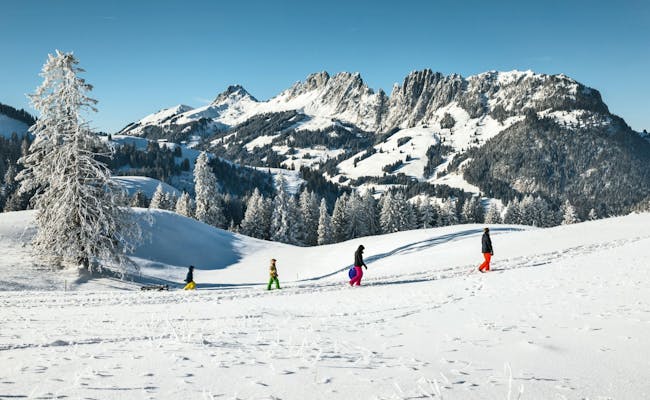 Sledding on foot (Photo: Switzerland Tourism Martin Maegli)
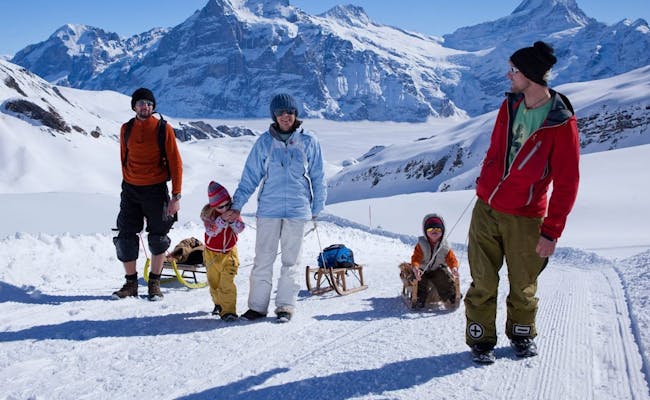 (Photo: Jungfraubahnen AG)
With the dog
For some, probably the most beautiful way to sled is with a dog sled. With a husky team you whiz through the white splendor in no time. Gently, the sled runners make their way behind the huskies. With professional help and well-trained dogs, you can experience a different kind of excursion on a guided sled tour.
 (Photo: Tschentenbahnen)
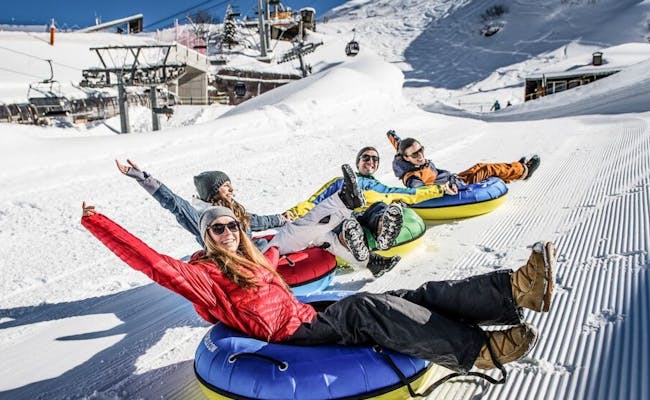 Snowtubing (Photo: Titlis Bergbahnen)
You don't need much to go sledding. A snowy slope is already enough. However, the range of groomed slopes is immense and if you are looking for inspiration for your next sledding trip, we have a selection of destinations all over Switzerland for you
Europe's longest illuminated toboggan run runs beneath the towering viaducts through an enchanting winter landscape. You can rent your toboggan at the train station in Bergün or bring it yourself. With the tobogganing ticket you can go up to the starting point by train as often as you like and go down again on the winding pass road, which is closed to traffic
 Sledding in Bergün (Photo: Switzerland Tourism André Meier)
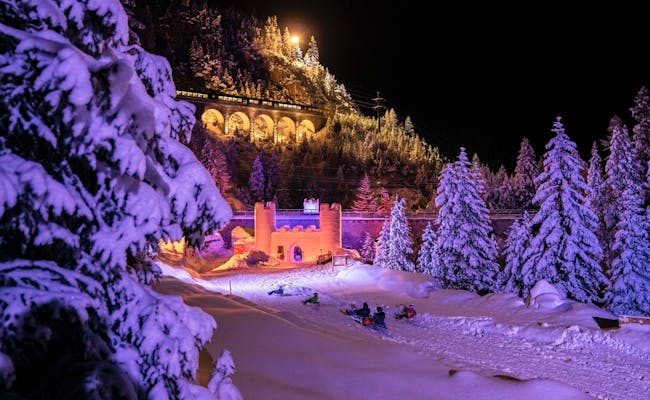 Night sledding in Bergün (Photo: Switzerland Tourism André Meier)
The sledding track in Lenzerheide winds down from the Scharmoin middle station to the valley station of the Rothornbahn with plenty of twists and turns. A ride down takes about 15 minutes before you hop back on the gondola for another trip back up to the middle station. Since the track is well-groomed and safe, it's perfect for families.
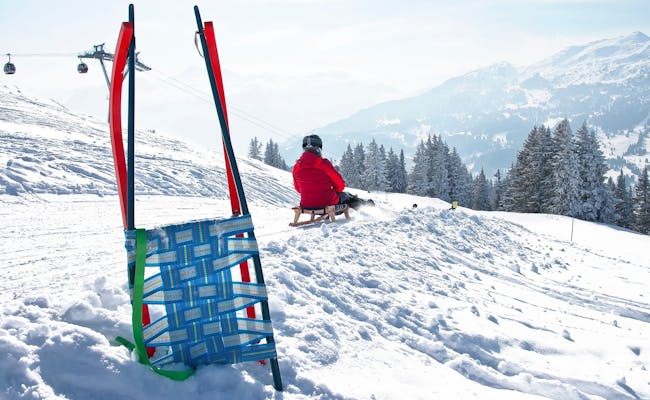 Sledding in Scharmoin Lenzerheide (Photo: Lenzerheide Holiday Region)
 Light Rider Lenzerheide (Photo: Lenzerheide Holiday Region Cemil Erkoc)
### Tobogganing on Kronberg From the summit of Kronberg down to Jakobsbad, you'll find the longest toboggan run in Eastern Switzerland. You can reach Kronberg via the cable car from Jakobsbad, where the freshly groomed run awaits you with initially gentler, followed by steeper sections. The Scheidegg inn along the way is perfect if you need a quick snack or want to warm up.
The toboggan run on the Zuger Hausberg can be easily accessed by the funicular from the valley station Schönegg. At the mountain station on Zugerberg, you'll find not just a wonderful view but also a well-groomed toboggan run. Plus, the Zugerberg restaurant provides a great opportunity for a pick-me-up with a tasty punch or a hot tea.
The Rigi attracts with scenic toboggan runs and winter hiking trails. On the Queen of the Mountains, you'll find various well-groomed descents. The runs are accessible by the Rigi trains, with options to arrive from Vitznau, Goldau, Weggis, or Kräbel.
 Sledding on Rigi (Photo: Rigi Bahnen)
 Sledding on Rigi (Photo: Rigi Bahnen)
At the foot of Titlis, the sledding run from Gerschni to Engelberg awaits you. In addition to breathtaking views of Titlis, you can enjoy a descent with flat, steep, and winding sections. The transport from Engelberg to the starting point is done via the cogwheel train that takes you up to Gerschnialp.
The sledding run in Elsigen Metsch near Adelboden takes you through forests and across open terrain. You won't have to get off or walk even once. The aerial cable car will then take you back up to Elsigenalp for your next descent.
On the local mountain of Adelboden, Tschentenalp, you’ll find wonderful sledding trails with varying levels of difficulty. The Tschentenbahn takes you from Adelboden to the starting point of the sledding run in a loop, where three cabins operate together. During peak season, from the end of December to mid-March, night sledding takes place on Wednesdays and Saturdays, allowing you to glide under the starry sky.
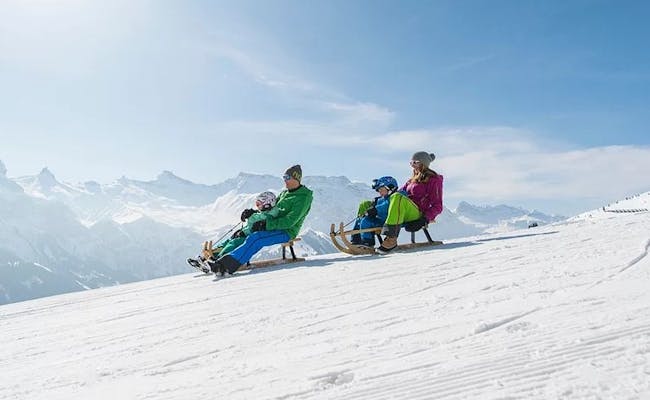 Tobogganing Tschentenalp (Photo: Tschentenbahnen)
 Sledding Tschentenalp (Photo: Tschentenbahnen)
While the Mediterranean Ticino attracts visitors in summer with its palm-lined promenades and gelato, it transforms into a sledding paradise in winter. The sledding track from Pian Nara winds through coniferous forests, across snowy slopes, and through picturesque village centers. The chairlift takes you from Leontica to Cancori and then up to Pian Nara, where the downhill thrill begins.
 Sledding in Nara (Photo: Ticino Tourism)
 Sledding in Nara (Photo: Ticino Tourism)
The valley station of the "Diablerets Express" is not far from the village center. From here, the cable car will take you to the ski resort of Le Meilleret, where the ride starts on the closed road to the Col de la Croix. On the first part of the descent you get a breathtaking view of the Diablerets mountain massif, before it zigzags through the forest back towards the valley
You can go sledding at any time of day or night. There are slopes specifically designed for night sledding. The mountain lifts operate in the evening as well, and the slopes are illuminated with floodlights.
But you can also try night sledding on your own with a strong headlamp and the right gear. We’ve put together an ultimate guide to night sledding that features 60 tracks for night sledding in Switzerland.
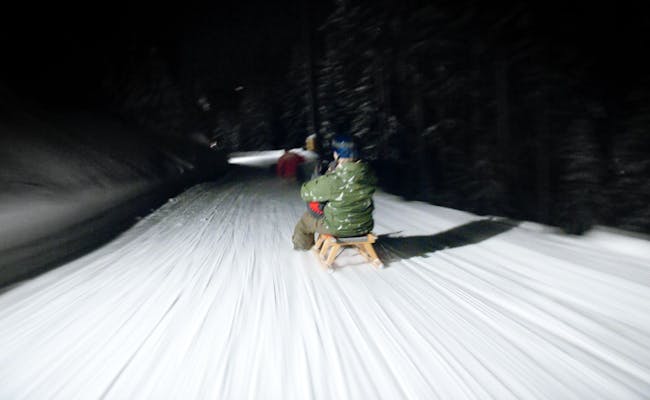 Night sledding (Photo: Holiday Region Lenzerheide Bernd Kammerer)
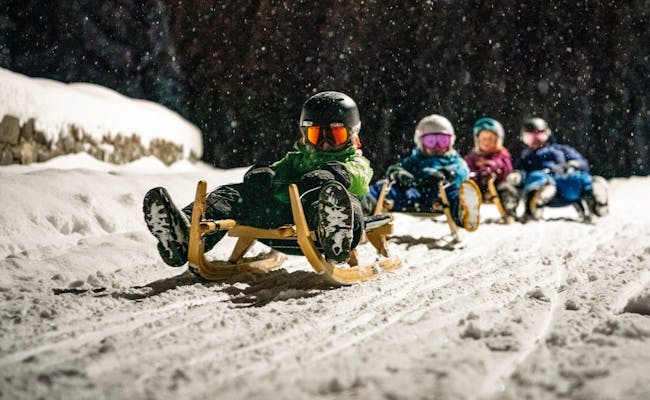 Night sledding in Bergün (Photo: Switzerland Tourism André Meier)
In Switzerland, around 7,000 accidents occur each year while sledding. More than half of these are caused by children and young people under the age of 16. So it's important to follow a few rules so that sledding fun doesn't end up in the emergency room.
 Sledding Riederalp (Photo: Aletsch Arena)
 Tobogganing Riederalp (Photo: Aletsch Arena)
Sledding can be a safe and fun experience for kids, especially when the first snowflakes start to fall, as long as you take the necessary precautions.
However, there are some rules to keep in mind to avoid any unpleasant surprises. In particular, children under eight often struggle to assess dangers in time and tend to react too late.
It's important for parents to supervise their children and ensure there are no potential hazards around. Ideally, you should sled with your kids away from obstacles like fences, pedestrians, skiers, cars, or walls. Gently sloping hills in open fields or deserted forest paths are the best options.
Moreover, children should only sled when they can independently steer and brake. Just sitting steadily isn’t enough. A helmet is also essential since falls can lead to head injuries.
In Switzerland, there are numerous sledding paths particularly suited for children. Below are four popular slopes for the whole family.
Nara Ticino
Here, you can sled under palm trees with a fantastic view. From the mountain station in Cancorí, there is a roughly 10 km long slope back to the village of Leontica. Suitable for children from 0 years Next stop: Leontica, Chiesa No parking available Prices for day pass lift: Adults 35 CHF / Kids 30 CHF
Schwarzsee Fribourg
The 300 m long sledding track in the Fribourg Pre-Alps is the perfect adventure spot for little snow bunnies. About 50 meters of elevation must be overcome, after which the sled needs to be pulled back up. Suitable for children from 0 years Next stop: Schwarzsee Hotellerie or Gypsera Parking available Prices: Sledding track free / Sled rental 5 CHF per hour
Elm Glarus
A 4 km long sledding track promises delightful sledding fun for the whole family after a gondola ride. The sledding enjoyment lasts about 20 minutes, and the middle section, which is a bit steeper, is particularly enjoyable. Suitable for children from 0 years Next stop: Valley station Sportbahnen Elm No parking available Prices for day pass cable car: Adults 36 CHF / Kids 20 CHF
Oeschinensee Bernese Oberland
From the mountain station, a roughly 4 km long slope winds through beautiful scenery past the wintery Oeschinensee. Suitable for children from 7 years Next train stop: Kandersteg Paid parking available at the valley station Prices for day pass cable car: Adults 44 CHF / Kids 31 CHF
 Sledding with Children (Photo: Aletsch Arena)
 Sledding with kids (Photo: Aletsch Arena)
It goes without saying that you should not put your baby on the sled alone. Special seats help your baby stay on the sled while you pull it up the hill. To ensure that nothing happens to your offspring, sled rental companies usually have child seats for babies and toddlers on offer. In addition, sleds can be made suitable for children in no time. For almost all models there are inexpensive backrests to attach. The foot bag from the stroller fulfills the same function on the sled and keeps your baby nice and warm.
With the right equipment, sledding is twice as much fun. If you don't have your own sled or would like to try out a different model, you can rent a sled for your sledding adventure. Often mountain railroads that prepare their toboggan runs offer various models for rent.
The following items are part of the equipment for sledding:
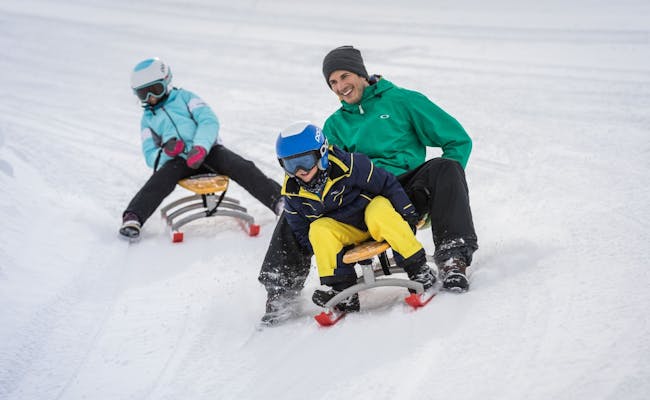 (Photo: Zermatt Tourism Pascal Gertschen)
 (Photo: Jungfrau Region)
In conclusion, we may state: Switzerland is a true sledding paradise. Everyone will find what they are looking for here: Families with small children, young amateurs and experienced sledding professionals. The landscape also leaves nothing to be desired
In a fabulous setting, sledding fans conquer the slopes of Switzerland with their toboggans. They master the curves, shifting their weight to steer, the soles of their shoes crunching and braking in the ice.


