
“Power Plant Construction in the Safiental” in Safien Platz
Sobre este local
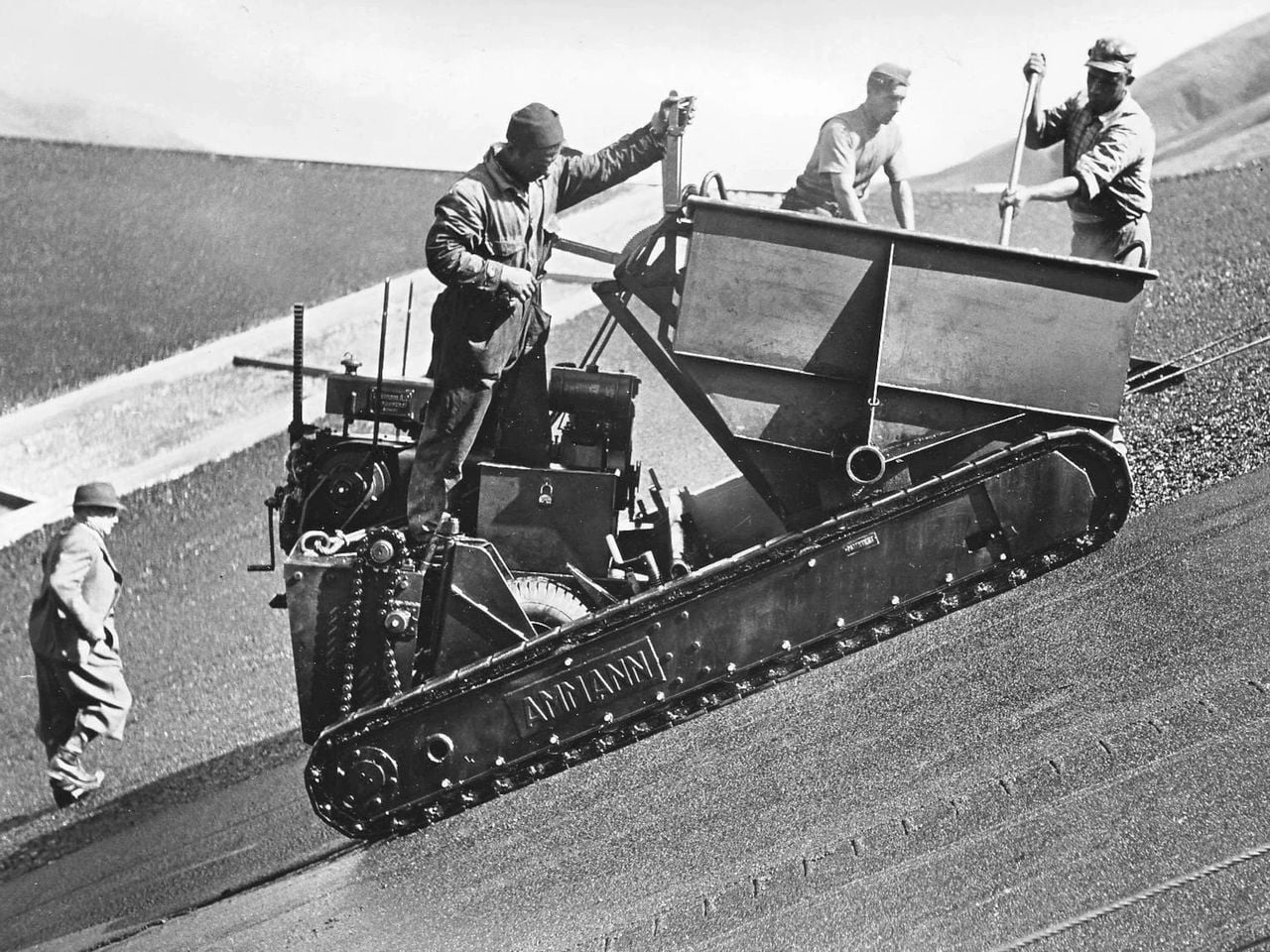
Barracks as far as the eye can see … At the major construction sites in Thalkirch and Safien Platz, numerous large, temporary barracks were erected to serve as workshops, storage facilities, cafeterias, offices, a hospital, and housing for up to 900 workers, most of whom were Italian. Smaller, somewhat more comfortable barracks were set aside for engineers and their families. Numerous trucks and ever-larger construction machines arrived on site. In contrast to the houses in the Turrahus area—which had been connected to a small private power plant with limited capacity since 1922—and those in Safien Platz—which had been connected to a small private power plant with limited capacity since 1925—the residents of the farms were still reliant on kerosene and carbide lamps as well as candles at that time. For them, it was not until the electrification that took place around Christmas 1952—concurrent with the delivery of electricity to the two major construction sites—that the dark nights came to an end. Unlike at the isolated construction sites far from populated areas—such as during the construction of the Zervreila or Grande Dixence dams— the construction sites in Safien Platz and Thalkirch—as well as the associated temporary infrastructure and housing—were located in the immediate vicinity of the locals’ homes and the Alpenrose, Rathaus, Brunnen, and Turrahus restaurants. In the exhibition film produced specifically for the exhibition, 28 eyewitnesses—all now between the ages of 76 and 103, who were children and young adults in the Safien Valley at the time—share their stories. Among the eyewitnesses are locals as well as descendants of an engineer and an Italian mechanic. They recount interpersonal encounters from the time of the power plant’s construction that remain unforgettable to this day. They also speak of linguistic and other experiences, of concerns and hopes related to the municipality’s finances, and of impressions, changes, and experiences that were completely new to them at the time. The exhibition, as well as the exhibition film by Philipp Gremper of the Safien Museum and Paul Avondet, film editor at www.peakfein.ch, features photos, documents, and plans from the archives of the construction companies HEW AG and Locher AG, the Graubünden Photo Foundation / Safiental Image Archive, the Geiger and Heini collections, the Rhaetian Museum, and the Médiathèque Valais-Martigny. Also on display are private photos, including those of engineer Erwin Horat-Hew, who lived in Wanne at the time, and of mechanic Angelo Matti, who lived with his wife Gina and their young sons Enzo and Elio in a rented room in Gassli. Highlights Other highlights include original items on loan from the Darms traveling cinema—which specialized in power plant screenings at the time—as well as two copies of the bilingual special edition of the “Tomüler Post” (“Corriere della Wanna”) dated March 27, 1954, available for reading. Note: This text was translated by machine translation software and not by a human translator. It may contain translation errors.