
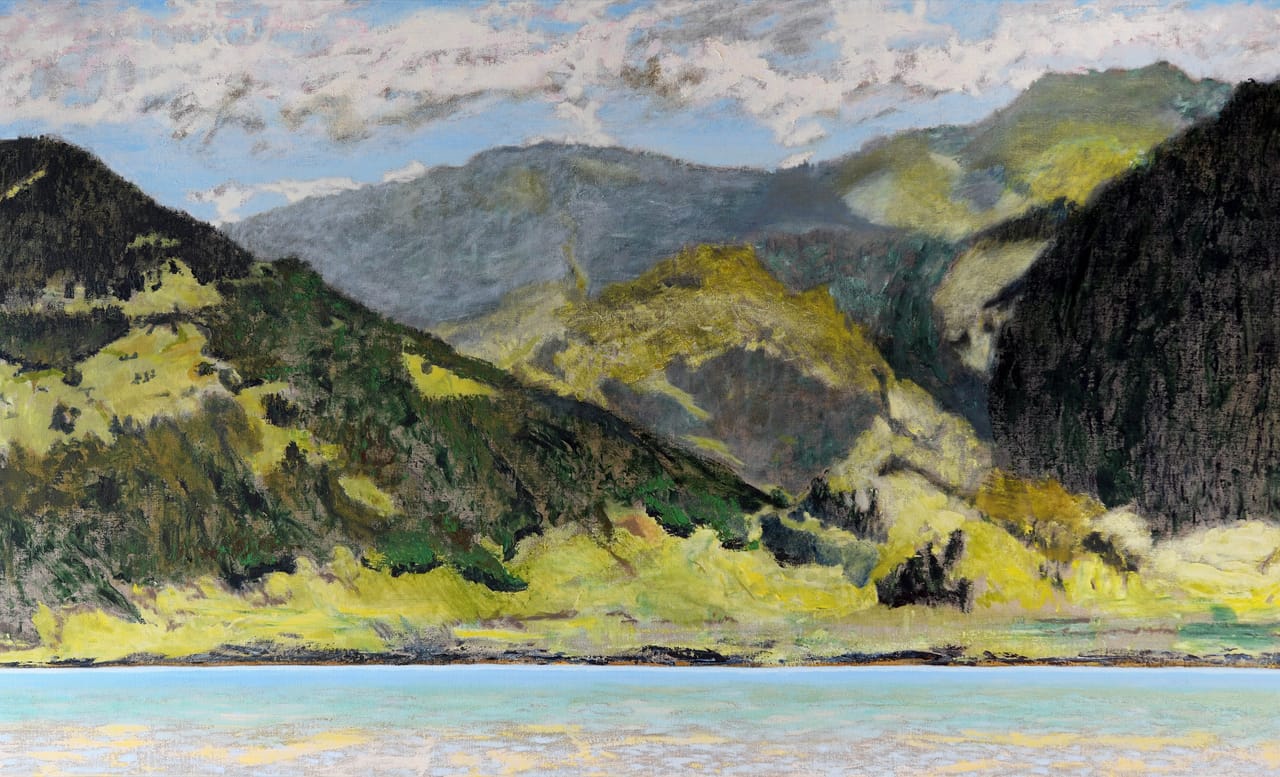
Rita Vansteenlandt 'Talkessel/ Region Schwyz/ Gersau, im Freien gemalt'
Об этом месте
“Rita Vansteenlandt paints in the loftiest and most honest sense of the word. She is thus, without meaning to be, the continuation of noble painting, of ‘plenairism’, the luminous current in the impressionist tradition. She paints what she experiences and sees, and after a period we would describe as an initial phase, she devoted herself exclusively to visible reality, to a reality that subtly builds a dialogue with time slipping away and its counterpart or companion – light. The move towards her marine paintings of clouds, beach and sea happens clearly, yet gradually. Aesthetics and reality go hand in hand. Her pictures of clouds, water and beach were initially mainly drawings on double-layered paper, from which strips were sometimes torn away, so that the paper is present just as much as a material as it is as a support for dots and lines. She regarded the sea with everything that belongs to it, that is, the foreground just as much as the background at different times of day and season. It is noteworthy that all the well-known marine scenes were drawn and, in part, painted from the same spot, but then on paper and with the intense and visible inclusion of the paper itself. Light plays a significant role throughout her work. Incidentally, her theme lends itself to repeated singing of, or holding on to, a quintessence of the elusive, and to the fact that in the short time during which one wants to look at it attentively, a metamorphosis has already taken place or things have acquired a different identity. What this causes at the North Sea is of course quite different from in the Swiss mountains, for example at a mountain lake or on the Vierwaldstättersee, where the many – muted or stronger – colours of the surroundings are reflected and the shadows are different too. For years, Rita Vansteenlandt observed and listened to the sea, the clouds and the beach as they lay there, poised or sheltered beneath a broad, bright and at times restless dome. She tightly framed the underlying image, but rendered it from her characteristic free approach to looking, mostly in large paintings that repeatedly emphasise a tripartite horizontality. Water and light are a genuine and decidedly compelling challenge for a painter who wants to capture reflections, depict rhythm and integrate movement into the static representation of a painting, and to summon colour in an often ethereal and fleeting environment such as air and sparkling water, which always escapes exact depiction. Delicacy dominates these marine paintings. Ochre colours, light green tones, blue bands surrounded by clouds, reflections in the water and in the puddles in the foreground, a delicate yellow that almost appears golden, and in the foreground and in the immeasurable background a purely pictorial rendering of air, clouds and something elusive, which surges forward unhindered from the far distance of a horizon. It was from this pictorial experience that she set out to paint in the mountains. Can one imagine a greater contrast? From an all-encompassing movement to a rather majestic stillness, at least to the eye. From the endless plain to monumental mountains, and a magical massif in the background, but also again a reflection. The mountain in the background is the Pilatusberg, to which special powers are attributed. A further challenge came to Rita Vansteenlandt when, from the spacious flat roof of the former Grand Hotel Brunnen, she looked out towards a lake surrounded by mountains far below on one side and, on the other, towards nearby vegetation, gigantic volumes succeeding one another and over which masses of cloud scratched or settled. For about six months she painted there at different times of day, admiring the variety of the spectacle which – just like the sea – lies beyond human reach and, perhaps thanks to that absence, displays wonderful authenticity and the greatest possible state of untouchedness. Alongside smaller works, where shades of grey can be seen, during her stay in Brunnen, Gersau and Schwyz she created an impressive number of large paintings, offering a panoramic view of the nature surrounding her and its visual language. Once again she did full justice to her reputation as a stubborn colourist and took a significant step, which can be seen as a surprising journey of discovery into contemporary painting. Even if the pictorial exploration of a specific natural phenomenon through concrete figuration is considered outdated by some, mainly because of the existential rejection of a precise rendering of things, Rita Vansteenlandt’s approach is nevertheless highly contemporary. It should not be an obstacle if someone knows their style and also masters this increasingly rare gift and achievement of rendering something concrete out of a visual emotion and a contemplative attitude. Her painting is not only an impressive rendering of a constantly changing reality. It does not only depict the monumental, darkness rising from fleeting banks of mist, a bright, sunlit wall contrasting with the shadow of vegetation, the gleam of snow patches and bare spots, the trembling of mist over expanses of water or the flight of low-flying, pale birds. It also conveys the subtle transition of dark green tones, of white and blue reflections blending into one another, of light dissolving into many shades, of luminosity and shadow, form and volume, reality and the densification of reality. Here Rita Vansteenlandt once again proves what she announced right at the start: the triumph of painting, the enviable gift of handling colour and volume properly.” Hugo Brutin, a.i.c.a.